


Running a cell or gene therapy program?
The handoffs between collection, manufacturing, and the clinical site are where biosafety gaps hide. See how Sitero helps sponsors and sites close them, from IBC review to staff readiness.
Who Owns the Dosing Window? A Biosafety Officer’s View of Autologous Handoffs
Every vendor owns a step. Nobody owns the window.
By Ryan Bartlett, Senior Biosafety Officer, Sitero
In an autologous program, a patient’s cells pass through at least four sets of hands before they come back. The apheresis center collects them. The manufacturer turns them into product. A courier moves them out and back. The clinical site receives, stores, thaws, and infuses. Each party has its own SOPs and its own staff.
The dosing window runs across all four. From a biosafety seat, the question is not only whether the product arrives. It is whether the people handling it know what it is, what controls apply, and who to call if something goes wrong.
The biosafety considerations change at every handoff. The people handling the product are often the ones least familiar with them.
Walk the chain
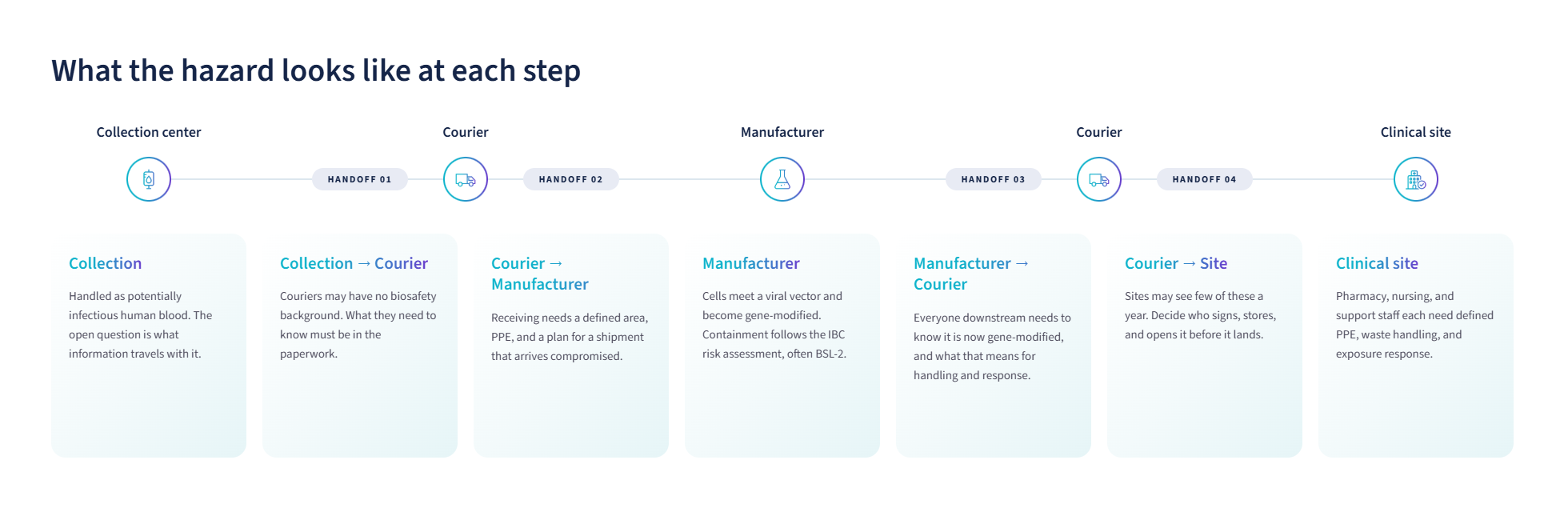
What the hazard looks like at each step
Collection. Before modification, the product is human blood and is handled as potentially infectious. Apheresis staff are usually well versed in bloodborne pathogen precautions. The question is what information, and instructions travel with the product when it leaves.
Collection to courier. Packaging, transport conditions, and emergency information now matter. Couriers handle many shipment types and may have no biosafety background. Whatever they need to know has to be in the paperwork, not assumed.
Courier to manufacturer. Receiving staff need a defined area, appropriate PPE, and a clear plan for what to do if a shipment arrives compromised. The cells are still unmodified at this point, but the hazard picture shifts quickly once processing begins.
Manufacturer. This is where the biosafety profile changes most. Unmodified patient cells are typically combined with a viral vector, and become a gene-modified product. Staff now face the vector itself, along with open manipulations, aerosol-generating steps such as pipetting and centrifugation, sharps, and cryogenic storage. Containment practices follow the IBC risk assessment, often BSL-2. Facilities built for product quality also have to make sure their gowning and cleanroom practices still provide the biosafety protection the risk assessment calls for. Waste and decontamination now need to address vector-contaminated material, and personnel need training specific to the vector they handle.
Manufacturer to courier. The product has now been genetically modified, typically with a replication-incompetent viral vector. Containment practices inside the facility follow the IBC risk assessment, often BSL-2. Once the product leaves, the people outside that facility need to know it is now a gene-modified product and what that means for handling, transport, and response.
Courier to site. The shipment arrives at a facility that may receive only a few of these products a year. Who signs for it, where it goes, and who opens the shipper all need an answer before it lands, including at 5 p.m. on a Friday. Receiving staff need to know what is inside and what to do if the container arrives compromised.
Clinical site. The product now moves through several departments, and each faces different considerations.
- Receipt and storage. Pharmacy or a cell therapy lab typically receives and stores the product. Cryogenic storage brings cold burn and oxygen displacement hazards, separate from the biological ones.
- Thaw and preparation. Thaw is often the first time staff handle the product directly. Containment practices, equipment, and location should match what the IBC-approved protocol specifies, including whether any step belongs in a biosafety cabinet.
- Administration. Nursing and clinic staff face needle, tubing, and splash exposures at the bedside. PPE should be defined by role and task.
- Patient care after infusion. Some protocols specify precautions for handling the patient’s body fluids or waste for a defined period. Staff outside the treatment team, such as environmental services and laboratory personnel, may never hear about them.
- Waste and decontamination. Bags, tubing, sharps, and surfaces each need a defined stream, disinfectant, and contact time, as the protocol specifies.
- Exposure response. Staff need to know what to do, who to call, and whether occupational health knows the program exists.
- Staff with special considerations. Pregnant or immunocompromised workers need occupational health review. That is a medical determination, not a unit-level one.
For most replication-incompetent products, risk to staff is low when controls are in place. The task is confirming they are in place before the first patient.
The oversight layer
Each organization in the chain may have its own review and oversight. The clinical site typically needs Institutional Biosafety Committee (IBC) review for gene-modified products under the NIH Guidelines. The manufacturer and other parties may have their own biosafety requirements and inspection expectations. These rarely share a timeline or a format.
The common failure is quiet. The IBC approves a protocol with specific containment, PPE, and waste requirements. Those requirements never make it into the procedures staff actually use. Everyone believes the approval covers practice. In reality, practice never picked it up.
Where it breaks
Two patterns show up most.
Product arrives before the site is ready. The receipt plan assumes the cell therapy pharmacist is on shift. The shipper lands at 5 p.m. on a Friday. Someone with no biosafety or cryogen training signs for it and finds a place to put it.
Staff improvise where the procedures end. The handling, disinfection, or waste step nobody wrote down. A question about the right PPE for a task. A site procedure that never picked up the containment language in the IBC-approved protocol.
In each case, every party did its job. The gap sat between them, or in a step no one owned. Industry commentary on CGT clinical operations now lists missed dosing windows and unmanaged vendor handoffs among the drivers of sponsor cost.
The fix: owners, SOPs, and trained staff before first patient in
The fix is unglamorous, and it works best when it is settled before activation.
One named owner per handoff for biosafety. A person with a role title on each side who knows the product’s hazards and who to call after an exposure. If you can’t name them, the handoff isn’t controlled.
Procedures that match the approval. Containment, PPE, decontamination, waste, and exposure response should reflect the IBC-approved protocol, and cover off-hours situations too.
Controls in place where the work happens. The right equipment, supplies, and information at the receiving, storage, preparation, and infusion locations, not only in a binder.
Role-based, hands-on training. Train each role on what it actually handles, and confirm it before the first shipment arrives.
Occupational health in the loop. Make sure the group that evaluates exposures and staff considerations knows the program is starting.
None of this replaces your partners’ safety programs. It closes the gaps between them.
Three questions to ask your team this week
- For each handoff, can you name who is responsible for biosafety on both sides, and do they know what the product is?
- If product arrived tomorrow outside pharmacy hours, has the person on shift been trained on the containment, PPE, waste, and exposure steps that apply?
Do your site’s procedures reflect the containment language in your IBC-approved protocol, and does occupational health know your program exists?
References
- U.S. Food and Drug Administration. (2026). Frequently asked questions — Developing potential cellular and gene therapy products: Guidance for industry. U.S. Department of Health and Human Services. https://www.fda.gov/media/183631/download
- Cupersmith, L. (2026, May 29). Why cell and gene therapy has not reached more patients — and why clinical operations is the bridge. Clinical Leader. https://www.clinicalleader.com/doc/why-cell-and-gene-therapy-has-not-reached-more-patients-and-why-clinical-operations-is-the-bridge-0001

Cell and gene therapy trials are scaling faster than biosafety infrastructure. Learn why IBC requirements, NIH Guidelines, and site activation challenges are delaying CGT programs, and how Sitero’s biosafety team helps sponsors stay ahead.

Stay informed about the latest proposed changes to select agent regulations and discover the significant updates outlined in the latest biennial review summarized in our latest blog post: