




55% of sites take more than 5 months to activate. Here is what that costs a CNS program on enrollment curves, burn rate, and competitive milestones.
Disconnected eCOA creates reconciliation delays that push database lock. Here is what integrated eCOA/ePRO in CNS trials actually requires from your EDC.

Disconnected eCOA creates reconciliation delays that push database lock. Here is what integrated eCOA/ePRO in CNS trials actually requires from your EDC.
Poor rater training inflates endpoint variance and erodes statistical power. Here is what CNS rater programs actually require to protect your primary endpoint.

Most clinical teams are not yet using AI in live studies, and the barriers are governance and validation, not technology. Here is what responsible deployment actually looks like.

AI tools that answer questions are not enough. Learn how Sitero's Ash AI delivers governed, audit-ready workflows for data management, study configuration, and insights.

Cell and gene therapy trials are scaling faster than biosafety infrastructure. Learn why IBC requirements, NIH Guidelines, and site activation challenges are delaying CGT programs, and how Sitero’s biosafety team helps sponsors stay ahead.
Clinical Operations Visibility Framework by Sitero
Evaluating a CRO for a biomarker-driven oncology trial? Use these questions on site selection, central lab coordination, EDC design, and screening failure management.
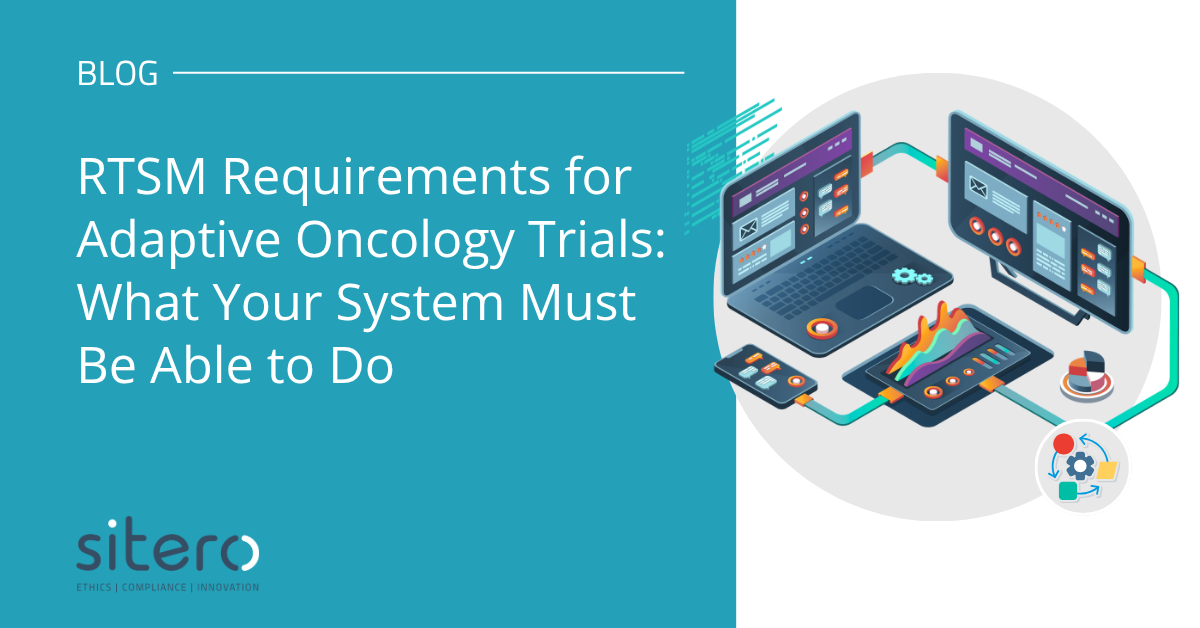
In an adaptive oncology trial, the RTSM must do four things that a conventional randomization system is not required to do: enforce configurable cohort and dose assignment rules in real [...]

Central lab workflow design determines enrollment velocity in precision oncology. Learn how to structure turnaround SLAs, result notification, and re-biopsy processes.
Biomarker-driven oncology trials enroll slowly because eligibility depends on a chain of steps — tissue procurement, sample shipment, lab processing, result communication, and site decision — each owned by a [...]
Blogrobgjryan2026-10-06T18:28:03+00:00