


The Clinical Operations Visibility Framework
A four-part framework for what real trial oversight requires, built for clinical operations leaders who need visibility their team can actually act on, not just a dashboard to look at.
Why This Matters
Sponsors can delegate execution. They cannot delegate accountability. When a trial runs into trouble, whether due to enrollment shortfalls, data quality issues, site performance gaps, or budget overruns, the question is not whether the sponsor knew. It is why they did not act sooner. That gap is almost always a visibility problem.
Clinical operations is increasingly asked to do more with less: more complex protocols, more sites, more regulatory scrutiny, often with the same or smaller team. In that environment, oversight that depends on manual reconciliation, reactive monitoring, or status updates that arrive after decisions have already been made is not oversight at all. It is documentation of what already went wrong.
What clinical operations teams actually need is structured, real-time visibility that supports early intervention, not just reporting that confirms what happened last month.
Why Visibility Is A Strategic Problem, Not A Reporting One
Clinical operations gets treated as a task-driven, execution-only function more often than it should. In practice, it requires strategic input early, before a protocol is finalized, and clear oversight all the way through closeout. Sponsors can hand off execution to a CRO or vendor, but accountability for the trial never leaves the sponsor. That means your team needs visibility that supports real decisions, not just status updates after the fact.
The risk of treating visibility as a reporting function is that it makes clinical operations reactive by design. When oversight is structured around milestone reviews and monthly status calls, the information that surfaces is already historical. By the time a site performance gap, query backlog, or enrollment deviation appears in a governance report, the window for low-cost correction has often already closed.
Strong operational visibility means your team has the information it needs to intervene early, at the site level, at the data level, and at the vendor level, before issues compound into timeline disruptions or inspection findings.
The Four Pillars Of Operational Visibility
Pillar 1: Early strategic input into study design
Clinical operations perspective should be built into the protocol before it is locked, not handed to a finalized document and asked to execute it. This means operational feasibility review before phase-appropriate sites are selected, realistic enrollment rate modeling, visit burden assessment, and early identification of logistical complexity such as central lab requirements, cold chain, or specialized equipment.
What commonly gets missed without this input: protocols with unrealistic visit schedules, ambiguous eligibility criteria, inadequate screening windows, or site selection that does not match patient geography. Many protocol amendments trace back to operational issues that were foreseeable at the design stage.
Meaningful early input is not a checklist review. It is operational and feasibility perspective woven into study design decisions, with a formal sign-off before the protocol is locked. The value is not in flagging problems after the fact; it is in preventing them.
Pillar 2: Defined oversight and escalation paths
Clear, documented expectations for vendor performance, CRA quality, and data stewardship need to be paired with an actual escalation path when issues arise. A governance structure on paper is not the same as a functioning oversight system. Someone must be responsible for reviewing metrics regularly, someone must have the authority to escalate, and there must be a defined response when a site, vendor, or data trend falls outside tolerance.
The breakdown most common in practice: issues that sit in monitoring reports without triggering action. CRA findings that recur across visits at the same site. Vendor deviations that accumulate unnoticed until they become a regulatory exposure. In each case, the problem was visible in the data. The oversight architecture did not convert that visibility into a decision.
Escalation paths work when they are documented, tested, and used. A governance meeting that reviews metrics without a defined protocol for what happens when a threshold is breached is a reporting function, not an oversight function.
See how Ash supports sponsor oversight in practice at sitero.com/sitero-ai.
Pillar 3: Structured, ongoing operational review
Consistent processes for reviewing site conduct, monitoring outputs, and data quality throughout the trial are more valuable than intensive review at milestone checkpoints. This includes meaningful review of SDV and SDR rates, protocol deviation trends, query aging, site performance benchmarks against comparable studies, and CRA workload and quality indicators.
The review cadence matters as much as the content. A monthly review process that consistently happens is more valuable than a rigorous review that only occurs at data lock or in preparation for an audit. What gets reviewed regularly gets managed. What gets reviewed only at milestones gets managed reactively.
Sponsors who rely primarily on CRO-generated quality reports without an independent internal view are structurally dependent on their vendors to surface problems that those same vendors are responsible for preventing. That is not a functional oversight model.
Pillar 4: Single source of operational truth
One connected system where enrollment, site performance, budgets, documents, and monitoring outputs live removes the reconciliation step that delays decisions in most clinical programs. This is less about any specific technology and more about whether your program’s operational reality is visible in one place.
Inconsistency across systems is not just inefficient. It creates blind spots. When different team members are working from different versions of the same data, decisions get made on incomplete or outdated information. The reconciliation effort before each governance meeting consumes time that should be spent on analysis and action.
A single source of operational truth means your team enters every status meeting with a current, shared view of where the trial stands. It means the sponsor and the CRO are operating from the same information. It means the question is what to do about what you see, not whether what you are seeing is accurate.
What Happens When Oversight Is Weak
Oversight failures rarely announce themselves. They accumulate in the background, each issue small enough to defer, until they compound into something harder to fix. The following patterns appear consistently in retrospective analyses of trial disruptions, inspection findings, and timeline deviations.
Reactive enrollment management
Enrollment concerns surface at monthly reviews rather than being flagged mid-month when the trajectory first shifts. Screen failure rates trend upward without documented root cause analysis. Sites that are underperforming relative to their activation benchmark are not identified and addressed until the shortfall is material. By the time enrollment recovery options are evaluated, the most effective interventions, such as site additions or protocol-level eligibility clarification, require timeline extensions to execute.
Document lag as a standard operating mode
eTMF completeness is reviewed at milestones rather than maintained as a continuous quality control activity. Essential document gaps are addressed in batches before an inspection or audit, not as part of routine oversight. The result is that the trial master file reflects a retrospective reconstruction of the trial rather than a contemporaneous record. This is a known inspection risk and a persistent one.
Fragmented data landscape
EDC, CTMS, budget tracker, and monitoring reports are maintained separately. Reconciliation is a manual effort before every governance meeting. The operational picture your team sees depends on who assembled the report and when they pulled the data. Different answers to the same factual question, depending on which system you check, are a structural indicator that the oversight architecture needs attention.
EDC, CTMS, budget tracker, and monitoring reports are maintained separately. Reconciliation is a manual effort before every governance meeting. The operational picture your team sees depends on who assembled the report and when they pulled the data. Different answers to the same factual question, depending on which system you check, are a structural indicator that the oversight architecture needs attention.
Recurring site findings
The same protocol deviations or GCP findings appear at the same site across multiple monitoring visits without a corrective action plan producing measurable improvement. This pattern indicates that monitoring is documenting problems rather than driving resolution. It is one of the most common findings in regulatory inspections of sponsor oversight programs.
Site activation drift
Activation timelines extend without a clear root cause analysis. Sites are activated and then go dormant without triggering a performance review. There is no defined threshold at which a site’s activation status or enrollment performance prompts a structured response. The program adds sites to solve an enrollment problem but does not have a mechanism for assessing whether the additions are performing.
Escalation ambiguity
When a vendor underperforms or a data trend shifts, it is unclear who decides whether to escalate, at what threshold, and to whom. Issues sit in reports without triggering a decision. The escalation path exists in a governance document but has not been tested in practice. When a real issue arrives, the process has to be invented under pressure rather than executed from a defined playbook.
What Happens When Oversight Is Weak
The table below maps each of the four pillars to the operational signals that indicate the system is functioning, and the warning signs that indicate it is not.
| Pillar | Healthy signal | Warning sign |
|---|---|---|
| Early input | Ops team reviews protocol draft before final. Feasibility outputs inform site selection. Enrollment model reviewed and stress-tested before first patient first visit. | Protocol handed off after final. First enrollment challenge surfaces mid-study. Amendment driven by an operational issue that was foreseeable at design. |
| Oversight and escalation | Vendor metrics reviewed monthly against defined tolerances. CRA quality indicators tracked and trending. Escalation path documented and tested at least once per quarter. | Repeated findings at the same site across multiple visits. Sponsor learns about a site issue from the CRO, not from their own oversight. Escalation process is unclear when tested. |
| Structured review | Protocol deviation trends reviewed and categorized monthly. Query aging tracked with defined thresholds. SDR targets set at study start and monitored throughout. | Data issues discovered at lock or during audit. Query aging consistently above 30 days without documented escalation. Deviation trends not analyzed until a regulatory question arises. |
| Operational truth | One system of record for enrollment, performance, and documents. Status meetings use live system data, not pre-assembled slides. Sponsor and CRO operating from the same view. | Status reports built from multiple separate trackers. Different answers to the same question depending on which system you check. Enrollment figure in the deck does not match what is in the CTMS. |
HOW SITERO SUPPORTS THIS FRAMEWORK
Sitero delivers full-service clinical trial operations from study startup through closeout, backed by the Mentor eClinical platform. The combination is designed to address each of the four pillars: operational expertise embedded early in study design, defined oversight and escalation by design, continuous quality review, and a single system where your program data lives.
Protocol feasibility and study startup
Sitero’s clinical operations team provides feasibility and startup support before your protocol is locked. This includes site identification, country selection, enrollment modeling, and operational risk review built into study design, not added after the protocol is finalized. The goal is to surface the operational issues that are most expensive to fix after the fact.
Risk-based monitoring and CRA oversight
Sitero delivers comprehensive, ICH E6(R2)-aligned risk-based monitoring with CRA management and quality control. Monitoring plans are tailored to your trial’s risk profile rather than applied as a standard template. CRA quality indicators are tracked and reviewed as part of routine program oversight, not only when an issue escalates.
Vendor and budget oversight
Sitero provides defined governance for vendor performance with documented escalation paths. Budget tracking is integrated into the same operational system as clinical performance metrics, so financial and clinical data are reviewed together rather than reconciled after the fact.
Mentor eClinical platform
The Mentor platform includes EDC, RTSM, CTMS and eTMF, eConsent, and payments in one connected system. Enrollment, site performance, data quality, and essential documents are visible from a single operational view accessible to both the sponsor and Sitero simultaneously. Status meetings use live system data. There is no separate reconciliation step before governance reviews.
Next Step
Sitero can walk you through how sponsor oversight is structured in practice using your trial type as the reference point. The conversation covers how the four pillars are operationalized in active programs, what the Mentor platform shows at each stage, and where Sitero’s clinical operations team adds capacity or expertise.
To schedule a conversation with the Sitero team here:
Evaluating a CRO for a biomarker-driven oncology trial? Use these questions on site selection, central lab coordination, EDC design, and screening failure management.
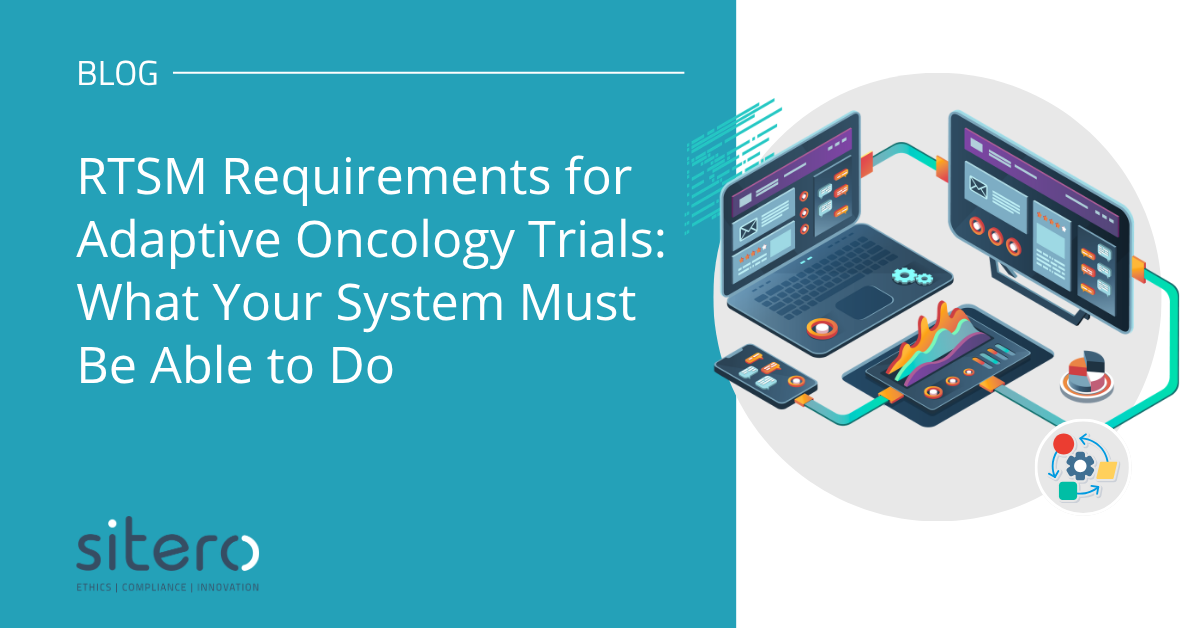
In an adaptive oncology trial, the RTSM must do four things that a conventional randomization system is not required to do: enforce configurable cohort and dose assignment rules in real [...]