

SCDM US 2026
Sitero is proud to exhibit at the SCDM US 2026 Annual Conference, the Society for Clinical Data Management’s flagship “Festival of Opportunity” for clinical data leaders. This premier gathering in Raleigh brings together data managers, biostatisticians, technologists, and innovators to advance clinical data excellence and shape the future of digital, AI-enabled, and patient-centric research.
Sitero aligns with SCDM’s mission by helping sponsors and research organizations operationalize modern clinical data strategies, from governance and standards to AI-driven automation and real-world data integration. Our solutions support high-quality, submission-ready data and more efficient trial execution, enabling teams to move faster while maintaining rigorous compliance and data integrity.
Visit Sitero at booth 332 at the Raleigh Convention Center, September 14–17, 2026, to explore how forward-looking organizations are transforming clinical data management with advanced technology, smarter workflows, and a truly data-driven mindset.
📍 Location: Raleigh, NC
📅 Dates: September 14-17
Be sure to register for a meeting with Sitero to learn more about how we are advancing clinical trials using the form below.
Scroll past to explore what Sitero has in store at SCDM 2026 – including a product showcase: Ash in Action: A Live Demo of Sitero’s Clinical AI Agent, on September 15th from 12:30-1:00 PM EST in Ballroom B, two expert panel sessions on ICH E6(R3) proportionality and AI-driven data management, plus a preview of the solutions we’ll be showcasing at Booth 332.
Book a meeting with Sitero at SCDM 2026

Ash in Action: A Live Demo of Sitero’s Clinical AI Agent
Manual query review. Check rebuilds from scratch. Cross-study data pulls that eat half your week. Clinical data teams deserve better tools, and Ash delivers them.
In this product showcase, SiteroAI’s CheRenee Zaragoza demos Ash, a clinical AI agent that works directly on your existing EDC, CTMS, and vendor systems, no data migration, no disruption. See live workflows for automated data management and plain-language portfolio insights that get your team to database lock faster.
Built inside a working CRO. Proven in practice. Available today.
CheRenee Zaragoza, M.S. | Director of Product Engineering, SiteroAI
CheRenee leads product development for Ash at Sitero. A former CRC who managed eight concurrent studies across Medidata and Inform, she brings firsthand clinical trial experience to building AI that actually fits how data teams work. She holds an M.S. in Applied Psychology from USC and is a published researcher in auditory cognitive neuroscience.
Join Sitero’s Dr. Joby John at SCDM during two sessions:
The ICH E6(R3) “Stop List”: Practical Proportionality
By early 2026, the transition period for ICH E6(R3) has officially concluded. “Proportionality” is no longer a theoretical best practice–it is a regulatory mandate. Despite this, many Data Management teams remain paralyzed by the legacy of “error-free” data, maintaining high-friction processes that yield diminishing returns for patient safety or trial results.
This provocative panel discussion offers a direct challenge to the status quo by introducing the CDM “Stop List” – a concerted elimination of traditional tasks that R3 empowers us to retire. Moving beyond introductory theory, our experts will explore the “Fit-for-Purpose” mindset, defining the shift from exhaustive documentation to the protection of critical-to-quality (CtQ) factors.
This session is about cutting corners; it is about the scientific and regulatory defense of reducing them. In the room, we will debate how to weigh oversight intensity matches the actual risk profile of modern trials, rather than historical habits.
Key Discussion Points:
-
The Death of “Error-Free”: dissecting the specific R3 language that distinguishes “errors that matter” from noise and providing a framework for setting Quality Tolerance Limits (QTLs) that optimize data review efforts without risking study integrity.
-
The Regulatory Defense Toolkit: practical strategies for defining “proportionate oversight” in inspection settings, including how to show what mattered (or what was not checked against) R3 expectations.
-
The “Stop List” in Action: live examples and group prioritization of “Light-Touch” monitoring opportunities across data listings, queries, and review checks, identifying the exact activities that Data Management teams must change.
-
From Anxiety to Confidence: how Data Management can gain the confidence to implement a “reduced effort” strategy and the vocabulary to defend it to auditors, ensuring resources are focused solely on data reliability and patient safety.
The AI Augmented Data Manager: From “Garbage In” to Intelligent Oversight
Inefficiencies are currently embedded in clinical data management workflows. According to industry research, disconnected systems and over-reliance on manual reconciliation are the primary reasons data tasks lag behind trial complexity. AI is no longer a futuristic concept; it is Data Manager’s new best friend and a critical tool in the modern arsenal.
This session moves beyond the hype to practical, “in-the-trenches” application. We will explore the specific AI models actively reshaping the landscape—from Smart Data Review algorithms that identify outliers faster than human review, to Automated Medical Coding engines that handle high-volume terms with precision. We will also examine emerging Generative AI and NLP interfaces that democratize data access, allowing users to “converse” with their database to generate listings without complex programming.
Our panel of experts will move beyond what these tools do to how they are implemented. The discussion will focus on how a “Fit-for-Purpose” AI strategy addresses the four critical pillars of success:
-
Transparency: Moving away from “Black Box” algorithms to ensure explainability in why a query was raised.
-
Humans in the Loop: Defining the critical “handshake” moments where AI suggests and the DM decides, ensuring oversight remains active.
-
Regulatory Compliance & Validation: Navigating the validation requirements to defend AI-assisted cleaning strategies to auditors (ICH E6(R3) alignment).
-
Data Readiness & Standardization: Preparing the underlying data architecture to prevent bias and ensure models are trained on high-quality, standardized inputs.
Audience Takeaway: Attendees will leave with a clear taxonomy of the AI models currently available and a strategic framework for evaluating them, ensuring they can distinguish between true innovation and marketing noise.
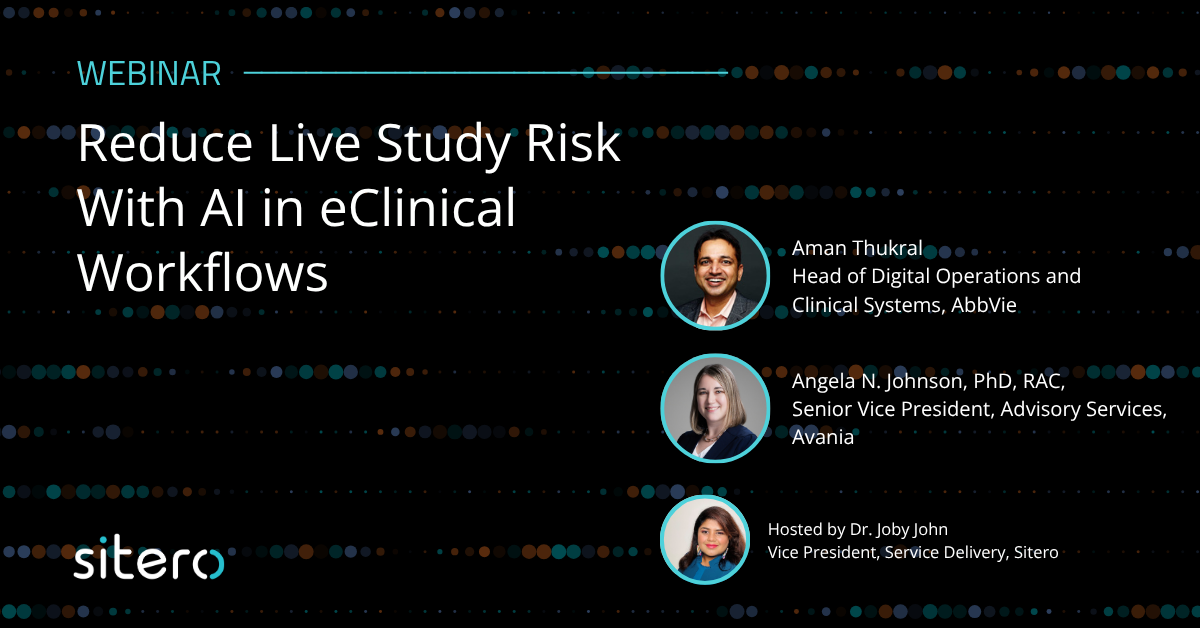
AI is reshaping how clinical teams manage live studies. Join Sitero, AbbVie, and Avania experts on August 26 to explore how AI is being applied across eClinical workflows today, from data review and anomaly detection to medical coding and continuous oversight, and what it takes to implement it safely in regulated environments.

Sitero is excited to be exhibiting at Outsourcing Clinical Trials Southern California 2026 on September 15-16. Learn more: